 |
|

|
|
Archives &
Museum Informatics
info @ archimuse.com
www.archimuse.com
published April 1998
updated Nov. 2010
|
|

 |
Time travels in virtual online landscapes
Virtual reality - A new challenge in dramaturgy?
|
|
|
|
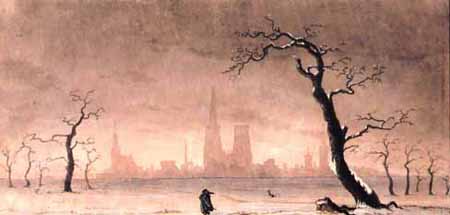
"Foggy winter morning"
Diorama by Karl-Friedrich Schinkel
|
|
|
| Table of contents
|
| |
|
|
|
|
1. VR Anno 1800
"Ladies and gentlemen. My name is Karl Friedrich Schinkel. I am
probably not known here in the French colonies, therefore I would
like to introduce myself.
I was born on the 13 March 1781 in the town of Neuruppin, about
50 miles northwest of Berlin, and have been working as an architect
in Prussia for a quite long time now and with remarkable and ongoing
success. The city of Berlin as it still is in your time bears
witness to this. Your colleagues from the time travel project
generously invited me to this conference in order to demonstrate
a VR system I developed with my student Carl Gropius - a name
that most likely doesn't mean anything to you either. Well, in
my time VR systems are a really big thing, in particular during
Christmas business. We call these systems 'mechanical
exhibitions', in academic circles they are called a little bombastically
'dioramas'1 . In the beginning
our VR system mainly consisted of a large circular panorama painting
constructing a closed room system which the user could enter and
where he could see foreign places, pre-historic scenes, historical
events, etc. The VR concept with the name "fast-time" the colleagues
from Berlin presented to me seems to be heading in the same direction.
In a second step we added animation features to the system, and
turned our pseudo-3-D system into a real 3-D system. We put the
panoramas on tracks and extended the system by additional foreground
paintings, which were also on tracks. Kinematics specialists developed
a mechanism that moved the paintings against one another in a
way that the user had e.g. the illusion of strolling around in
a real town. And this without any head-mounted display or any
other head-tracking device. We finally made the breakthrough by
integrating various multimedia modules: Educated speakers supplying
the user with background information, an orchestra that generated
appropriate acoustics and a complex lighting design for the foreground
and background images gave the system the necessary atmospheric
quality for the first time. In particular we are proud on our
"fog"-feature. With this feature we can wonderfully model the
morning fog in a landscape panorama or the smoke in a battle panorama.
Dr. Braun, is there any comparable feature in your VR system?
Please have a look at the VR model of our VR system, which was
kindly generated by the colleagues from the time traveling project.
I think it is about time to pass over to Dr. Braun. Thank you
very much for letting me present my system without an appointment.
I wish you a successful conference and good bye."
|
|
|
| 1. Further information concerning
dioramas can be found in: Birgit Verwiebe, Panorama, Diorama und
die ÇLinden', in: Unter den Linden, Exhibition catalogue GKB,
Berlin 1997.[back]
|
|
|
2. How many horses are under our hood? Design
and features of the time-travel-engine
"Dear Mr. Schinkel, thank you very much for your introduction.
I wish you a pleasant journey back to the 19th century." As you
have seen time travels are a nice thing, even though, or exactly
because they show quite clearly that virtual worlds are not only
an achievement of the information society on the edge to the 3rd
millennium, as the recent media VR hype wants to make us believe.
Mankind has always constructed virtual worlds. Among the creators
were artists, musicians, and painters, not to mention numberless
storytellers. In our paper we would like to talk mainly about
the experiences in dramaturgy and design we had during the development
of an online VR landscape. This online VR landscape which is still
under construction is supposed to serve as an exhibition platform
for museums, archives and libraries. The VR scene is an as realistic
as possible reconstruction of Friedrichswerder, a central quarter
of the city of Berlin. We have chosen Friedrichswerder because
it was once an important center for fashion and media in Europe.
Besides, many famous buildings of Karl Friedrich Schinkel are
to be found in this area. And last not least
it was an urban area for which complete architectural data were
available from one of our project partners: the Bauakademie2
. Friedrichswerder had been reconstructed for three years: 1850,
1928 and 1993 (Figure 1). Since the building development normally
changes gradually, we could follow the architectural development
of this quarter from 1830 until today almost continuously. Only
the massive devastation in World War II interrupts this continuity.
|
|
|
|
|
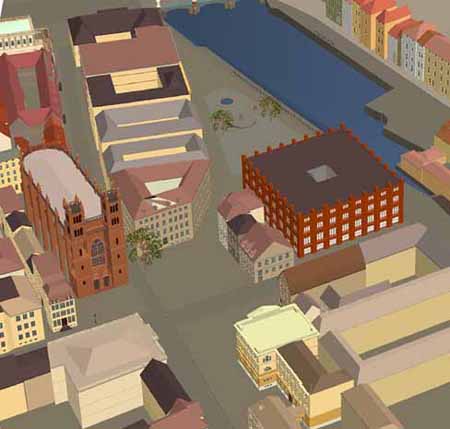
Figure 1 : Northern part of the digitally reconstructed Friedrichswerder
in 1850
|
|
|
| The digitally reconstructed Friedrichswerder builds up the
interface for our online time traveling system. The user can walk
around in this quarter and can go back and forth in time. Due
to this time-traveling function we consider our VR platform more
a 4-D world rather than a 3-D world. Depending on the chosen time
the user then moves in a scenery consisting of objects that are
specific to this time. Only time specific buildings are presented
to the user, and the street environment, public transportation
and other vehicles, every day objects, window displays and advertisement
posters, people that are dressed in the fashion of the time, etc.
These scene objects can be moving objects, e.g. a car, or can
be animated by audio and video sequences as for example a radio
or a TV set. The user can get additional information, whether
it is on a certain object of the scene or on a more general historical
context, in separate multimedia browsers which are activated via
so-called feature objects in the VR scene (Figures 2-3). Additional
information can be made available in all different types of digital
media: text, image, 3-D object, sound and film. Access to an online-database
can be offered in these browsers by integrated hyperlinks.
|
|
|
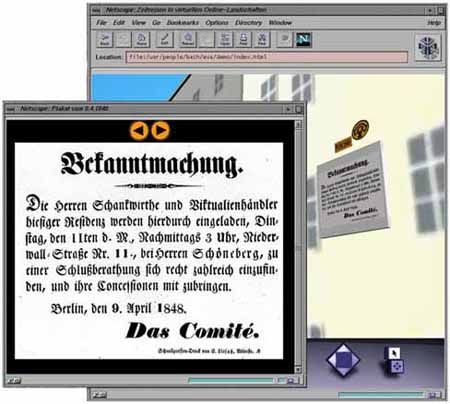 Figure
2 : Feature object "Public posters" Figure
2 : Feature object "Public posters"
|
|
|
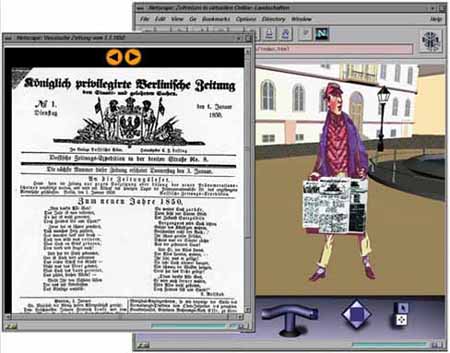 Figure
3 : Feature object "Newspaper man" Figure
3 : Feature object "Newspaper man"
|
|
|
| The architectural and other set objects are located on a central
VR server platform. The additional data that can be called via
feature objects are located at the information supplier site so
long as performance permits and the institution is provided with
an online database. The VR server is an open platform for museums
and archives. This allows for several online presentations with
different content simultaneously. For the prototype system we
focus on three subjects which are supposed to be time traveling
examples: the architectural history of the city of Berlin, the
historical changes of mass media and the history of consumer products.
Allow us two words on the technical side of the project: the VR
scenery is developed in VRML and Java, PostgreSQL is used to realize
the access to underlying databases.
|
|
|
| 2.All architectural models © BAUAKADEMIE
Gesellschaft f¸r Forschung, Bildung und Entwicklung mbH, Berlin.[back]
|
|
|
3. Luggage and lodging: Which objects match
the time?
In this section, we would like to address several design issues
which we have not yet solved to our full satisfaction.
The convincing power of a VR landscape, in particular when
it is about a historical scene, depends a lot on its atmospheric
qualities. The atmospheric appearance of a VR scene is determined
by the visual aesthetics, including the degree of dirtiness
of the generated objects, as well as by the often neglected
space acoustics. Computer-generated architectural models are
simply too clean - they are only convincing when the story is
about new buildings. Otherwise street dirt is missing and the
whole range of real life traces of decline caused by time and
environment. With current software unfortunately these effects
can only be realized with an extremely high effort. In our project
the absence of such effects is particularly visible, because
for a lot of set constructions we use photographs. The consequence
is that new, proper objects are next to visibly old and dirty
objects even though they come from the same time period.
The problem of aesthetics mainly concerns scenes of those times
before the invention of photography. Imagine that our time machine
would really allow us to take brilliant and sharp color shots
in the 19th century, and import them into the present. The photographs
would certainly not convince us because our collective vision
of the 19th century is influenced by paintings. There bright
colors and hard contrasts had no place. Therefore for the scenery
we try to adapt the visual aesthetics of the 19th century city
and landscape painting.
When the problems of appearance quality are solved a time variable
VR platform can supply a range of new and interesting options
for exhibitions with historical objects and the mediation of
historical knowledge. The biggest advantage of VR landscapes
is certainly that they can visually supply a historical context
for museum objects. In classical exhibitions the context is
usually reduced to the literal frame in which the object is
presented. The historical context is then available as an explanation
text and therefore purely mentally accesible. At best visualizations
of the object are supplied in catalogues and can be studied
after the museum visit at home.
As opposed to the procedure described above a VR landscape
allows us to connect a single historical object with the appropriate
urban context and its real life component. In exhibitions with
objects related to a historical change this is of particular
advantage. The historical context is, so to speak, automatically
delivered by the time traveling function as long as the development
takes place in the time span covered by the system.
The contextual relation of museum objects supports multiple
synergies when the VR platform is used for several exhibitions
with diverse issues. This can be accompanied by very practical
advantages e.g. when objects of the exhibition with subject
A can be used as set for the exhibition with subject B, and
vice versa. Therefore we are hoping that the tremendous work
effort we have had to put in the set objects of our VR world,
could be reduced if a future VR platform was intensely used
by museums. In addition, an interesting synergy in content can
also be the result. A user who is for instance interested in
an exhibition focus "History of consumer products" which is
planned by us, will be seduced to also look at information concerning
"History of mass media". In this case the connecting element
would be the change in product advertisement.
The strong context relation of exhibition objects also has
its problematic side. Obviously a connection to a specific every
day context demands correct dating and spatial categorization
of the object. Since most museum objects are usually presented
in isolation, exact information on their life time and distribution
areas is not needed. Therefore we had to undertake substantial
research to get this missing information for the set objects
of our VR landscape.
Another problem pointed out by historians is the historical
distortion for which such a VR platform could be blamed. On
a pure visual level the differentiation between the museums
object and the illustrative set fades for the user. But that
is exactly the point. These boundaries are explicitly supposed
to vanish: the fading of boundaries is the suggestive power
of the VR platform. The illustrative objects are designed in
order to recreate history as a whole not only a fragmented piece.
It only has to be made clear what they could have looked like
that in the chosen time and in the reconstructed urban area
in which they could have existed. In contrast, museum objects
are defined rigidly. In fact, we could have avoided these accusations
by countering that no historian was able to help us when we
needed "hard" facts.
Finally, we acknowledge a problem concerning user guidance.
Users of the system must be able to receive information on the
historical status of an object via adequate navigation systems.
The problems of historical framing also demonstrated that an
exhibition realized on an online VR platform made greater demands
on an interdisciplinary approach than any conventional show.
Such an enterprise is unthinkable without a functioning cooperation
between archivists, librarians, photographers, historians of
diverse special knowledge and a strong willingness to communicate
with the involved VR specialists.
|
|
|
4. Packaged tours vs. 'call of the wild':
Navigation within online 4-D worlds
As in real life, in virtual reality the question to whom the
travel offer should be made, must be addressed. In both situations
two opposite types can be found: on the one side the kind of
traveler who wants to know before hand what will be expected
and who wants to be pampered and permanently informed. On the
other side we have the knap sack freak on his search for adventure
and authenticity. This candidate would feel uncomfortanle with
organized travel and be worried about his freedom.
As in real life both traveling groups could interfere in a
negative way. Just think for instance of visual or acoustic
hints integrated in the scene which could possibly destroy the
knap sack freak's illusion or think of the misuse of the VR
platform as a 3-D adventure game which brings the server to
a standstill and therefore disturbs a serious traveler on his
educational journey. But unlike the real world, the VR-technology
has more options available in order to allow both groups to
go their own way without interfering. The travelers can switch
between free exploration and guided tour at any time. This was
the main reason for our decision to offer both possibilities.
The guided tour is addressed to users who have no experience
with the navigation in 3D worlds. It is also addressed to users
looking for very specific museum information. We are planning
to establish guided tours for all three main subjects. With
the help of a separate browser window the guided tour will lead
the visitor step by step to the historically interesting sites.
With every stop additional information to the subject will be
supplied (Figure 4). The visitor can decide when the next step
will be made. Any time he can switch to the free navigation.
For museums which want to use the VR platform for an online
exhibition the guided tour is an important design element.
|
|
|
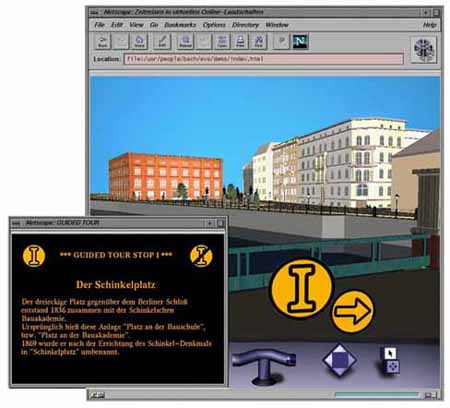 Figure
4 : The "Guided Tour" feature of the time traveling system Figure
4 : The "Guided Tour" feature of the time traveling system
|
|
|
|
Much more difficult to design is the navigation assistance
for users who want to move freely. In fact, there are two problems
to be solved which are not directly related to each other. First,
the user has to be provided with feedback on where he is moving,
virtually, and what time he currently is in. Otherwise he will
be a victim of the 'lost in space' phenomenon, which here also
means a 'lost in time' syndrome as well. In order to prevent
this we planned some kind of pilot display which is inserted
as a standard object in a separate browser window. In this window
the actual time is indicated, and can be changed by turning
on a time wheel. Furthermore, this window includes a city map.
On the map the actual location of the visitor as well as all
the stops of the guided tour are indicated. With a mouse click
on the map the visitor can move to another site. With a click
on the guided tour stop he leaves the free navigation mode and
latches onto a guided tour.
Secondly, the user needs assistance in order to locate those
objects behind which additional information might be hidden.
Therefore in the map of the pilot display all feature objects
will be indicated as hot spots. In the scene itself only the
special arrangement of objects will point out on feature objects.
Otherwise the interest in free exploration would be lost. Whenever
the set contains very detailed or moving objects, or the lighting
and acoustics noticeably differ from the surroundings, the visitor
can expect additional information.
|
|
|
5. View back on the future of online VR exhibitions
Let us undertake another time travel and let us look back on
the near future of our VR platform and other similar VR worlds.
Considering the speed of technological development, five years
from now should be enough. Well, looking at the year 2003, the
view is rather foggy. Still, three developments seem to be quite
clear. One development concerning the users of VR landscapes,
one concerning the museums and one concerning the data both
users and museums are dealing with.
We'll find far more activity in development of VR worlds. Museum
educators and teachers obviously overcame their mental reservation
against DOOM and other computer games, and encouraged the development
of multi-user VR worlds populated with avatars.
The old-style museum belongs to the past. Classical museum
functions are no longer under the control of a single curator.
Many museums have specialized in purchase, filing and conservation
of objects.
The copyrights on images including the copyrights on 3-D presentation
are mostly hold by big media and telecommunication companies.
Some museums turned into data brokers or exhibition agencies.
They react to sensational media events like "The sinking of
the Titanic" and organize exhibitions of current interest. This
is a development which we actually took for granted when we
started to develop our online VR systems.
PICS is as dead as Z3950 - even Dublin-Core and Iconclass are
seriously ill. The winner is Extra-Medium-Large. We could have
used such a meta data solution on the basis of XML, even for
our small project. But one look at the confusion in standards
discussed by the museums, archives and libraries convinced us
to desist from using meta data.
Final result: We can look back optimistically on our future.
|
|
|
6. Acknowledgment
The research work presented in this paper is financed by DFN-Verein
with funds from DeTe-Berkom GmbH. Associated museums and archives
of the time traveling project are Landesmuseum f¸r Technik und
Arbeit, Mannheim, Deutsches Rundfunkarchiv, Frankfurt and Berlin
and WerkbundArchiv, Berlin. Sponsors are Silicon Graphics, Alias/Wavefront
and IEZ AG. BAUAKADEMIE Gesellschaft f¸r Forschung, Bildung und
Entwicklung mbH has kindly permitted us to use its digital architectural
models of the quarter Friedrichswerder. |

Last modified: April 1, 1998. This file can be found below
http://www.archimuse.com/mw98/
Send questions and comments to info@archimuse.com |
|